
The 2026 Agentic Stack: Cutting Through the Noise of Autonomous AI
Feel overwhelmed by the explosion of AI agent tools? You’re not alone. Here is the "stack view" of the platforms, components, and ecosystems defining the future of autonomous software.

Today I was discussing our AI Strategy with my friend Michael Hunger and we realized we had to first be clear on what level in the stack are we talking about. I thought it would be helpful to document the stack view so it is helpful for everyone.
As we approach 2026, we are moving past the “toy demo” phase of generative and agentic AI. The next two years are about production-grade reliability, governance, and complex multi-agent orchestration. To navigate this, we must stop looking at these tools as a disorganized pile of logos and look at it as a “stack view” to understand how these pieces fit together to build autonomous systems.
Here is a perspective on Agentic Stack as we head toward 2026.
The Visual Guide: The 2026 Agentic Stack
The landscape has evolved into a foundational base supporting two distinct implementation paths: building your own custom stack or adopting an integrated enterprise ecosystem.
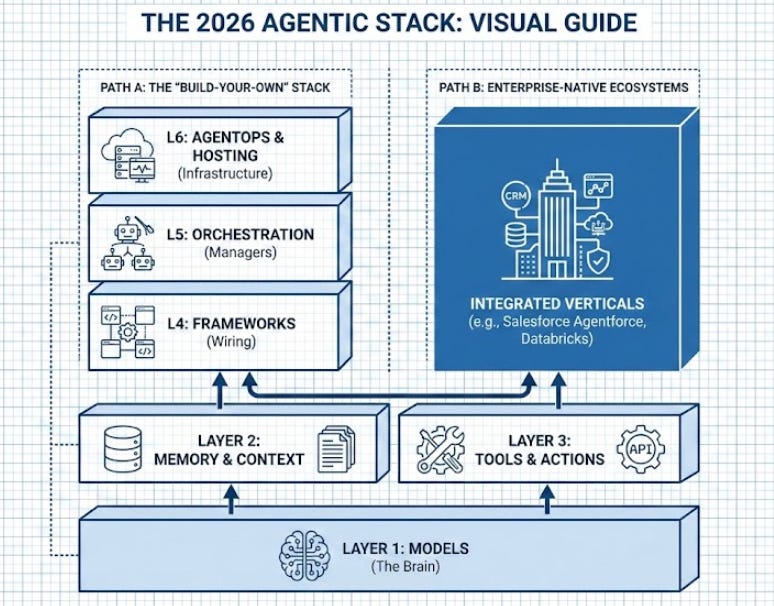
The Foundation (Layers 1-3)
These are the non-negotiable ingredients required for any autonomous system, regardless of which path you choose.
Layer 1: The Cognitive Foundation (Models)
This is raw intelligence. While big players like GPT-4o and Claude 3.5 remain the standard for complex reasoning, the 2026 will also see more Small Language Models (SLMs). We will be seeing a rise in capable, locally runnable models crucial for private, cost-effective agents.
Layer 2: Memory and Context
An agent without memory is just a chatbot that forgets you every five minutes similar to gold fish. This layer handles how agents access external knowledge (RAG) and manage short-term vs. long-term state.
We are partnering with many startups like Mem0, Zep, Cognee and many more who are building graph based memory layer for developers.
Layer 3: Tools and Action Interfaces
Intelligence is useless without the ability to affect the world. This layer bridges thinking and doing, moving past custom scripts toward standardized connectivity—specifically the Model Context Protocol (MCP). MCP provides a universal plug-and-play interface that allows any agent to instantly connect to enterprise tools or local databases. By moving from manual "spaghetti code" to these standardized gateways, agents have evolved from chatbots that talk about work to autonomous systems that actually execute it.
We are building MCP server interfaces for all our capabilities from core database to our graph algorithms to Aura operations and custom agents built by our customers.
Path A: The “Build-Your-Own” Stack (Layers 4-6)
This path is for developers and product teams building highly customized, unique agentic applications. You buy the best components and wire them together.
Layer 4: The Connective Tissue (Frameworks)
How do you wire the brain to the tools? Frameworks provide the libraries for constructing reasoning loops. LangChain remains the Swiss Army Knife for gluing components together, while LlamaIndex is the powerhouse for data-centric agents querying complex documents.
Layer 5: Orchestration and Multi-Agent Systems (MAS)
Critical for 2026 As tasks get too complex for one singular agent, we need frameworks to manage teams of agents. LangGraph & AutoGen are essential for creating stateful, cyclical flows where agents can debate, collaborate, and iterate on problems.
Layer 6: Hosting and AgentOps
We are moving away from running agents in terminals. This layer includes hyperscaler hosting (AWS Bedrock Agents, Azure AI, Vertex AI) and the emerging AgentOps category—tools to monitor performance, trace reasoning steps, and ensure guardrails prevent agents from going rogue.
Path B: The Enterprise-Native Ecosystems
This is the newest and fastest-growing category heading into 2026. These are not just components; they are vertical platforms that collapse Layers 2 through 6 into a single, governed environment rooted in existing corporate data.
Examples include Salesforce Agentforce and Databricks Agent Bricks.
The Philosophy: Instead of building an agent and trying to teach it about your business data, you build the agent inside the platform where your data already lives.
The Advantage: They solve the two biggest headaches: Integration and Governance. The agent already has permission to access the necessary data, and its actions are constrained by existing enterprise security rules.
The Trade-off: You gain speed and security, but you lose the granular control offered by the “Build-Your-Own” stack.
Summary: The 2026 Reality Check
The confusion in the market usually stems from mixing up these layers and paths. To keep it straight as we head toward 2026, identify your role:
Are you a “Builder” creating a unique product? You will live in Path A.
Are you an “Operator” automating internal workflows on top of existing data? You will likely choose Path B.
For data infrastructure companies like Neo4j, we have to decide what layers we will play in. Building foundational model don’t make sense but we could have a role to play in every other layer either building or integrating or powering.
Sudhir, excellent stack breakdown—love how Layers 1-3 form the non-negotiable cognitive base while Paths A/B clarify builder vs. operator choices.
Your Neo4j lens on Layer 2 (graph memory via Mem0/Zep/Cognee) and MCP interfaces really shines—graphs are perfect for contextual recall in multi-agent flows.[linkhub]
For enterprise risk use cases like mine, where does Aura Agent fit best: Path A orchestration or Path B governance?